
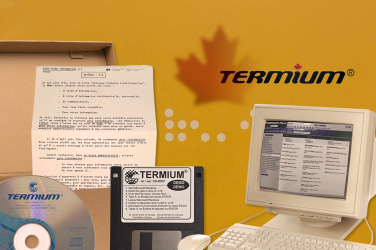
This year, TERMIUM® is celebrating its 50th birthday! This tool, which has become one of the largest terminology banks in the world, provides access to over 1.4 million terminological records in a vast array of fields in English, French, Spanish and Portuguese.
However, did you know that behind this immense inventory of words lies an extraordinary story, in terms of both human and technological achievement? From its modest beginnings as a simple collection of index cards to its status as a resource consulted daily by thousands of people, TERMIUM® traces the evolution of translation, terminology and communications in Canada.
Before TERMIUM®: Hunting for the right word
The story begins in 1953 when the Translation Bureau created the first Canadian terminology service.
This time period saw the invention of the first polio vaccine and the beginning of a new era for molecular biology with the discovery of the structure of DNA. New discoveries were plentiful, and translators were faced with a major challenge: finding the right terms to accurately describe innovations at a time when dictionaries struggled to keep up with the rapid evolution of knowledge.
Then, once these terms were researched and validated, they had to be recorded so that the people who needed them, such as colleagues in translation, could consult them.
Well before databases and search engines, it was the humble yet functional shoebox that was used to organize the index cards on which each term and its equivalents were recorded.
Overflowing boxes: A need to get organized
In the 1960s and 1970s, the world was changing quickly. These decades marked the beginning of the space age and the invention of the microprocessor. Specialized fields were proliferating, and the demand for translation was increasing rapidly.
The collection of index cards was also growing. Clearly, the shoeboxes were no longer going to cut it.
The terminology unit put their innovative skills to work: the records were placed in rotary filing cabinets, which made searches easier. It was a pivotal moment for communications, and terminology—like translation—was also undergoing rapid growth. By 1975, some 100 terminologists worked at the Translation Bureau, and the need for a more efficient centralized tool became obvious.
TERMIUM® is born!
The year 1976 marked a turning point.
That year, the Department of the Secretary of State of Canada acquired the University of Montréal’s Banque de terminologie (BTUM), laying the groundwork for what would become TERMIUM®. In fact, the letters “U” and “M” in the word TERMIUM® are a nod to the University of Montréal!
The acquisition made it possible to centralize the information recorded on all the index cards. TERMIUM® 1 was born! This software created a bridge between two methods and two eras, and the transition was made from paper to computers. TERMIUM® opened the door to a new way of managing and disseminating language knowledge.
From TERMIUM® to TERMIUM Plus®: The digital revolution
Over the years, knowledge of TERMIUM® spread. Specialists outside the Translation Bureau demonstrated a growing interest in its content.
In the 1990s, users could access TERMIUM® on CD-ROM, the cutting-edge technology of the day. Paper-based updates were a thing of the past: hundreds of thousands of terms would now be on a disk that users could consult directly at their workstation.
And then came the Internet.
In 1999, TERMIUM Plus® (opens in new tab) was launched. This new version, which was housed on the Web, provided remote access to updated data and offered more functionalities as well as writing tools.
In 2009, the Translation Bureau created the Language Portal of Canada. The same year, TERMIUM Plus® was integrated into this new language resources platform intended for use by the general public. TERMIUM Plus® became free of charge and available not only to specialists but also to anyone looking for just the right word. Its popularity quickly reached new heights.
Fifty years of collaboration: Time to celebrate!
TERMIUM® owes its half-century of existence first and foremost to the spirit of collaboration.
From the beginning, TERMIUM® has been augmented through the joint work of terminologists, translators, subject-field specialists and many different partners.
Throughout the years, this collaborative network has effectively surpassed the borders of the Translation Bureau: initiatives such as joint projects with the World Intellectual Property Organization, collaboration with the Office québécois de la langue française, contributions to ISO subcommittees and partnerships with the Geographic Names Board of Canada have all left their mark on TERMIUM®.
Every new collaboration is an opportunity to add new terms to the databank, enhance existing records and improve the quality of information available to users.
What will the next 50 years bring?
Since its creation 50 years ago, TERMIUM® has constantly evolved to reflect the needs of the people who use it. This approach is now more relevant than ever. Indeed, the changes brought about by the rise in AI, particularly the development of large language models, have highlighted the importance of structured and standardized terminological data. TERMIUM Plus® is a cornerstone resource for safeguarding and disseminating such data.
As machine translation technology continues to evolve, terminologists play a vital role in ensuring the terminological accuracy of the resulting texts. Their language expertise is relied upon to develop strategies for improving the way GCtranslate, an AI tool created for federal departments and agencies, uses Government of Canada terminology.
One thing is certain: 50 years later, TERMIUM® continues to evolve, while staying faithful to its primary mission of putting the right words in the right hands.
Do you have a memory or story connected to TERMIUM® or a favourite term that you found in the databank? Tell us about it in the comments and wish TERMIUM® a happy 50th birthday!
